







China Top 10 Thermal Bond Non Woven Fabric Manufacturers
China has become a significant source of thermal bond non woven materials for hygiene, filtration, medical, packaging, and industrial applications. Its manufacturers combine broad production capacity with increasingly precise quality control. This article introduces ten notable Chinese manufacturers and examines what makes each one worth attention.
The evaluation considers manufacturing experience, fiber selection, bonding consistency, surface feel, tensile strength, and delivery reliability. It also reviews practical details, including factory scale, equipment capability, customization options, certifications, and communication during sampling. A dependable supplier should provide clear technical data, stable production records, and traceable quality procedures. Product claims alone are not enough.
Real purchasing decisions often begin with a sample roll. Buyers may inspect softness by hand, test thickness with a gauge, and compare web uniformity under bright light. Small variations can affect converting speed and final product performance. Some manufacturers offer impressive specifications, yet their response time or batch stability may require closer examination. That matters.
This list is intended as a research guide rather than an absolute ranking. Market positions can change with new equipment, raw material costs, export experience, and customer feedback. Information should be verified directly with each manufacturer before signing a contract. A factory visit, independent testing, or pilot order can reveal details that brochures do not show. In this competitive sector, the strongest Thermal Bond Non Woven supplier is not always the largest one. It is the company that consistently matches technical performance, service expectations, compliance needs, and realistic production schedules.
Thermal Bond Nonwoven Fabric: Definition and Manufacturing Process
Thermal bond nonwoven fabric is a textile made without weaving or knitting. It uses heat-sensitive fibers that bond when heated. Polyester, polypropylene, and bicomponent fibers are common choices. The final fabric may feel soft, springy, or slightly firm. Its structure depends on fiber type, web density, and bonding temperature.
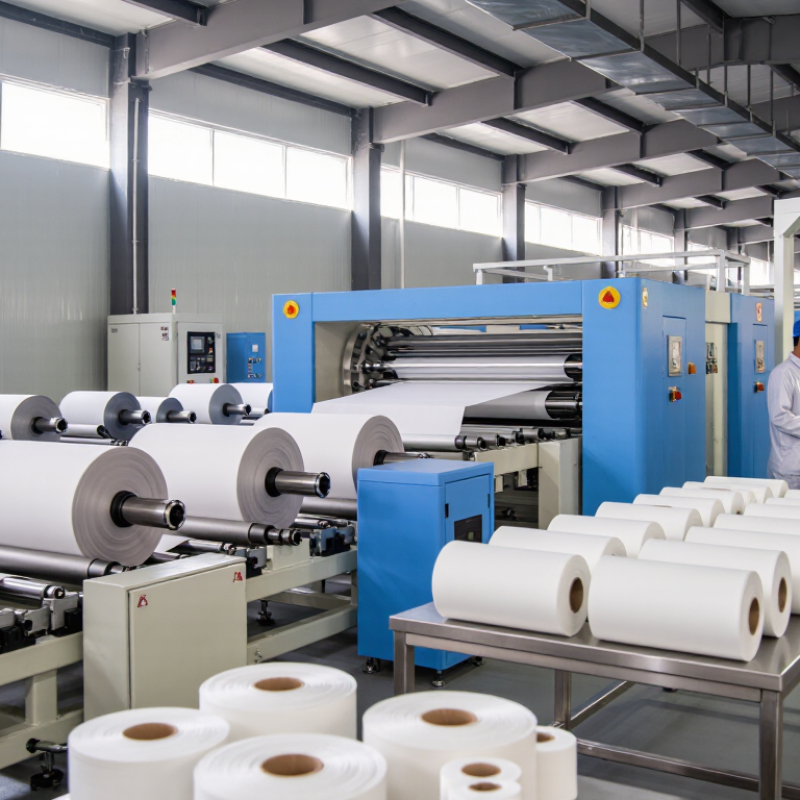
Manufacturing begins with fiber opening and blending. A carding or air-laying machine then spreads the fibers into a loose, even web. The web enters a hot-air oven or heated calender. Heat activates the fiber surface, while pressure helps form stable bonding points. Cooling follows immediately to preserve thickness and shape. Some factories add cutting, embossing, laminating, or antistatic treatment. These steps must match the fabric’s intended use.
Quality control is practical and detailed. Technicians check basis weight, thickness, tensile strength, air permeability, shrinkage, and surface uniformity. A small temperature change can alter softness and strength. That detail is easy to underestimate. Manufacturers in China often adjust production lines for filtration, hygiene, furniture, automotive, and insulation applications. Trial samples should be tested under real conditions, not only in a laboratory. No process is flawless. Fiber blending, oven speed, and cooling time may still require repeated adjustment.
| Rank | Manufacturer Profile | Typical Production Region | Thermal Bonding Technology | Common Fiber Composition | Typical Basis Weight | Typical Product Width | Common Applications | Relevant Quality Standards |
|---|---|---|---|---|---|---|---|---|
| 1 | Manufacturer Profile 01 | East China | Through-air bonding and hot-calender bonding | Polyester, polypropylene, or bicomponent fibers | 15–150 g/m² | 1.6–3.2 m | Filtration media, hygiene products, furniture padding | ISO 9001 |
| 2 | Manufacturer Profile 02 | South China | Hot-air through bonding | Polyester and low-melt polyester bicomponent fibers | 30–200 g/m² | 1.8–3.6 m | Automotive interiors, mattress panels, insulation layers | ISO 9001 |
| 3 | Manufacturer Profile 03 | Central China | Thermal calender bonding | Polypropylene, polyester, and polyethylene-polypropylene fibers | 12–120 g/m² | 1.6–3.0 m | Medical disposables, packaging, agricultural covers | ISO 9001 |
| 4 | Manufacturer Profile 04 | North China | Through-air bonding with web forming and cross-lapping | Polyester and bicomponent staple fibers | 40–250 g/m² | 2.0–4.0 m | Construction membranes, sound absorption, bedding | ISO 9001 |
| 5 | Manufacturer Profile 05 | East China | Hot-air bonding for high-loft nonwoven webs | Polyester, recycled polyester, and bicomponent fibers | 50–400 g/m² | 1.8–3.2 m | Quilting, apparel interlining, filtration, home textiles | ISO 9001 |
| 6 | Manufacturer Profile 06 | Southwest China | Hot-calender bonding with embossing capability | Polypropylene, polyester, and polyethylene fibers | 15–100 g/m² | 1.6–2.8 m | Packaging liners, disposable products, crop protection | ISO 9001 |
| 7 | Manufacturer Profile 07 | South China | Through-air bonding and thermal point bonding | Polyester, polypropylene, and PLA-based fibers | 20–180 g/m² | 1.8–3.2 m | Personal care, wipes, filtration, sustainable packaging | ISO 9001 |
| 8 | Manufacturer Profile 08 | North China | Thermal bonding after carding and needle pre-entanglement | Polyester, polypropylene, and recycled fibers | 60–300 g/m² | 2.0–4.0 m | Automotive trim, geotextile composites, protective padding | ISO 9001 |
| 9 | Manufacturer Profile 09 | East China | Thermal point bonding and precision calendering | Polypropylene, polyester, and bicomponent fibers | 10–80 g/m² | 1.6–3.0 m | Hygiene backsheet, medical packaging, tea and filter bags | ISO 9001 |
| 10 | Manufacturer Profile 10 | Central China | Through-air bonding for bulky and resilient structures | Polyester, polypropylene, and low-melt bicomponent fibers | 80–500 g/m² | 2.0–3.6 m | Mattress insulation, furniture cushioning, automotive acoustics | ISO 9001 |
| Process Stage | Technical Description | Key Process Variables | Resulting Fabric Characteristics |
|---|---|---|---|
| 1. Fiber Selection | Staple fibers are selected according to the required strength, softness, loft, thermal resistance, and end-use performance. | Fiber polymer, length, fineness, cross-section, melting point | Determines handle, resilience, bonding temperature, and durability |
| 2. Opening and Blending | Compressed fiber bales are opened and blended to create a uniform feedstock. | Opening intensity, blend ratio, feed rate, moisture level | Improves fiber dispersion and basis-weight consistency |
| 3. Carding | Fibers are separated and oriented into a web using carding equipment. | Card speed, worker-stripper settings, web delivery speed | Forms an evenly distributed web with predominantly oriented fibers |
| 4. Web Cross-Lapping | The carded web may be layered in alternating directions to increase thickness and improve strength balance. | Laydown angle, number of layers, conveyor speed | Enhances cross-direction strength and product bulk |
| 5. Thermal Bonding | Heat softens bonding fibers or thermoplastic fiber surfaces, joining fiber intersections without liquid binders. | Air or calender temperature, dwell time, pressure, line speed | Creates cohesion, dimensional stability, and controlled loft |
| 6. Cooling and Stabilization | The bonded web is cooled under controlled tension to stabilize its final structure. | Cooling-air volume, web tension, cooling-roll temperature | Reduces shrinkage and helps maintain thickness and width |
| 7. Finishing | The fabric may be slit, laminated, perforated, embossed, treated, or wound into rolls. | Slitting width, winding tension, surface treatment, roll diameter | Produces application-specific formats and surface properties |
| 8. Quality Inspection | Finished rolls are checked for physical uniformity and application performance. | Basis weight, thickness, tensile strength, air permeability, shrinkage | Confirms consistency against the agreed technical specification |