


Choosing reliable China Top Waterproof ATV Sound Bar Suppliers requires more than comparing catalog prices. Off-road audio faces mud, rain, vibration, dust, and sudden temperature changes. A capable supplier should understand these conditions and explain how each product is tested.
A Waterproof ATV Sound Bar should offer more than a sealed enclosure. Buyers should examine the IP rating, speaker cone materials, mounting strength, wiring quality, and amplifier protection. Stainless steel brackets can resist corrosion near wet trails. Reinforced grilles may protect drivers from stones and branches. Bluetooth range also matters when the rider carries a phone several meters away. Small details become important.
Ask suppliers for test reports, product samples, factory photographs, and clear warranty terms. Confirm whether testing covers water exposure, vibration, salt spray, and continuous playback. Do not rely on attractive claims alone. A low price may hide weak connectors or limited technical support. It may not. Verification remains essential.
Experienced sourcing teams often compare several factories before selecting a partner. They inspect production consistency, packaging, labeling, and replacement-part availability. Communication quality provides another useful signal. Can the supplier explain a failed test honestly? Can engineers adjust brackets or wiring safely? These questions reveal practical competence.
Some suppliers may advertise “top quality” too easily. That wording deserves careful review. The strongest candidates provide measurable specifications and repeatable evidence. For ATV dealers, distributors, and outdoor enthusiasts, dependable performance protects both reputation and investment. A thoughtful supplier search can turn a basic accessory into a safer, more enjoyable riding experience.
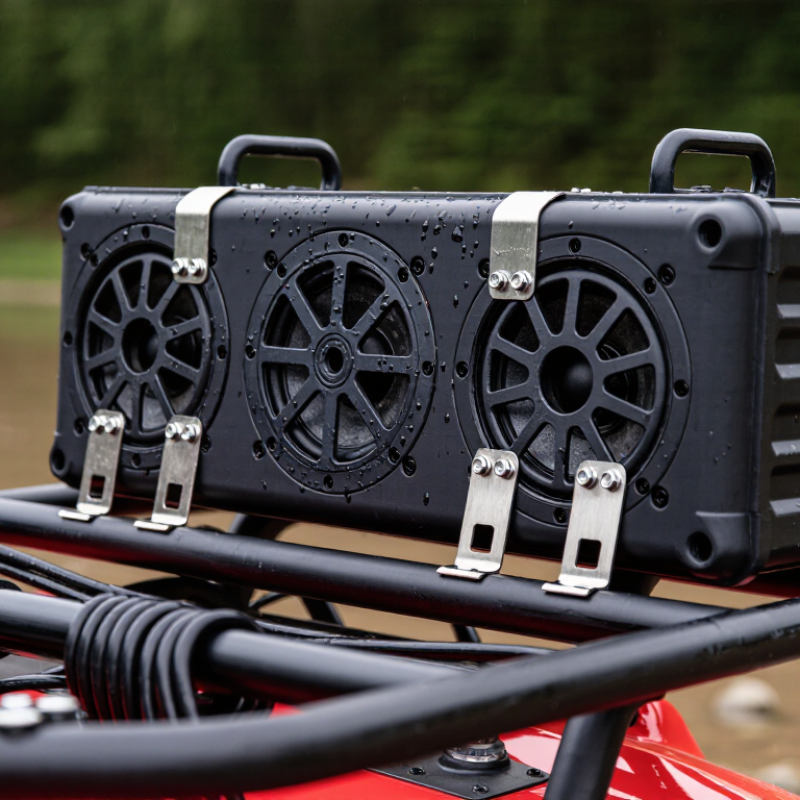
A high-quality waterproof ATV sound bar must survive more than a light splash. Mud, vibration, dust, and sudden temperature changes test every component. Look for a verified IP rating, sealed speaker grilles, corrosion-resistant fasteners, and protected wiring connections. IP ratings matter, but they do not tell the whole story. A unit may resist water yet fail after repeated shocks on rocky trails.
Sound quality also depends on practical engineering. Strong midrange audio should remain clear when the engine is running nearby. A stable Bluetooth connection, simple controls, and reliable volume adjustment improve trail use. Check the mounting system carefully. Thick brackets, locking hardware, and anti-vibration pads can prevent unwanted rattling. Reputable suppliers should provide test details, warranty terms, wiring diagrams, and replacement support. Vague claims deserve caution.
Tips: Ask how the sound bar was tested. Was it sprayed, submerged, or only inspected visually? Check whether the stated IP rating applies to the complete unit, not one small component. After installation, inspect cable seals and brackets after every few rides. I have seen “waterproof” equipment fail because the connector was left exposed. No product is invincible. Even a well-built sound bar needs sensible maintenance, especially after muddy or wet trips.
Chinese suppliers are competitive in the ATV audio market because they combine manufacturing scale with flexible product development. Many factories produce speakers, amplifiers, wiring kits, and mounting hardware in the same region. This reduces transport time between production stages. It also supports faster design changes. A buyer can request a compact sound bar, stronger brackets, or different control layouts without rebuilding the entire supply chain.
Water resistance is more than a marketing phrase. Experienced suppliers test enclosure seals, cable entries, buttons, and speaker grilles against water and dust exposure. They should provide clear IP-rating documents, sample test records, and production inspection reports. Some factories also conduct vibration testing, salt-spray checks, and temperature cycling. These details matter on muddy trails, where water can enter through a poorly protected connector. Small failures become expensive.
Pricing is another advantage, but low cost alone is not enough. Chinese manufacturers often offer mold sharing, component sourcing, and moderate minimum order quantities. This helps smaller distributors test demand before placing large orders. However, the market is not flawless. Some samples perform well but lack consistent assembly quality during mass production. A careful buyer should inspect pre-production units, verify audio output, and review warranty procedures. Supplier communication can be quick, yet technical English may still create misunderstandings. Clear drawings and written inspection standards remain essential.
China Top Waterproof ATV Sound Bar Suppliers?
When comparing Chinese ATV sound bar suppliers, start with protection, not loudness. Ask for the tested IP rating and the test standard used. A sealed enclosure should resist mud, rain, and pressure washing. Inspect the speaker grille, cable glands, and control buttons closely. Small gaps can become expensive problems.
Audio performance also needs practical testing. Request a sample before placing a large order. Test vocals at trail speed, bass at moderate volume, and distortion after one hour. Check Bluetooth stability around metal frames and nearby electrical equipment. Ask whether the amplifier includes thermal protection and overcurrent protection. Details matter. A higher wattage claim means little without measured output data.
Supplier reliability depends on more than factory photographs. Review quality procedures, production capacity, spare-part availability, and response time. Confirm mounting hardware fits common ATV bar sizes and survives vibration testing. Ask for clear documentation, including user instructions, wiring diagrams, and compliance reports for your target market. Certifications should be verifiable, not simply printed on a document. Warranty terms must cover water ingress, loose connections, and early speaker failure.
No supplier is perfect. One overlooked connector can weaken a good design. Compare sample results, audit records, and communication quality together. A supplier that admits limitations may deserve more trust than one promising everything.
| Comparison Dimension | Common Entry-Level Specification | Performance-Focused Specification | Premium / Heavy-Duty Specification | What to Verify with the Supplier |
|---|---|---|---|---|
| Waterproof Protection | IPX5 or equivalent water-jet resistance | IPX6 water-jet resistance for exposed mounting positions | IP67, providing dust protection and temporary immersion resistance when properly sealed | Request the complete IP test report, test conditions, sample configuration, and whether the rating applies to the finished sound bar. |
| Bluetooth Connectivity | Bluetooth 5.0 or later with basic audio streaming | Bluetooth 5.2 or later with improved connection stability | Bluetooth 5.3 or later, with stable pairing and optional multi-device support | Confirm supported profiles, operating distance in open conditions, pairing memory, latency, and regional wireless compliance. |
| Audio Power | Approximately 20–40 W RMS total | Approximately 40–80 W RMS total | Approximately 80–150 W RMS total, depending on enclosure and amplifier design | Compare RMS power rather than peak or PMPO figures, and request distortion measurements at the stated output level. |
| Speaker Configuration | Two full-range drivers, commonly 3–4 inches each | Two full-range drivers with passive radiators or dedicated low-frequency enhancement | Multiple full-range drivers, separate tweeters, or a tuned enclosure for wider frequency response | Ask for driver size, impedance, sensitivity, frequency-response data, and an independent or standardized test method. |
| Power Supply | 12 V DC input with basic overcurrent protection | 12 V DC input with reverse-polarity, overvoltage, and thermal protection | Wide 9–16 V DC operating range with automotive transient protection | Confirm operating voltage, standby current, fuse requirements, polarity protection, and compatibility with the vehicle electrical system. |
| Battery Option | No internal battery; powered directly from the vehicle | Integrated rechargeable lithium battery for short off-vehicle use | Higher-capacity battery system with battery-management and charging protection | Verify battery chemistry, rated capacity in Wh, charging time, protection circuit, replacement policy, and transport documentation. |
| Control Methods | Basic buttons for volume, playback, and power | Wireless remote control, wired control panel, or handlebar-compatible controller | Multiple control options with sealed buttons and clear status indicators | Check button sealing, remote range, glove-friendly operation, controller cable length, and resistance to vibration. |
| Input Interfaces | Bluetooth and sealed USB charging port | Bluetooth, USB playback or charging, and auxiliary audio input | Sealed USB-C, auxiliary input, microphone input, or configurable wired audio input | Confirm connector sealing, USB function, supported audio formats, port covers, and corrosion resistance. |
| Mounting System | Universal brackets for common roll-bar diameters | Adjustable brackets with rubber isolation pads | Reinforced corrosion-resistant brackets with anti-vibration hardware | Request supported bar diameters, bracket material, fastener grade, torque guidance, and vibration-test results. |
| Housing Materials | Molded ABS or similar engineering plastic | UV-resistant plastic with sealed grille and reinforced mounting points | UV-stabilized housing, corrosion-resistant grille, gasketed seams, and strengthened internal supports | Ask for material specification, UV-aging data, salt-spray results, grille material, and enclosure assembly details. |
| Environmental Durability | Basic splash and outdoor-use protection | Protection against dust, rain, vibration, and moderate temperature changes | Documented testing for vibration, temperature cycling, UV exposure, and corrosion resistance | Request test standards, test duration, operating-temperature range, and whether testing covers the final production version. |
| Safety and Compliance | Basic electrical safety documentation | Applicable EMC, radio, and restricted-substance documentation for the target market | Complete market-specific compliance package with traceable laboratory reports | Confirm required certifications for the destination market, report validity, test-lab accreditation, and product-model consistency. |
| Quality Control | Basic incoming-material and final-function checks | Functional testing, waterproof inspection, audio testing, and aging checks | Documented inspection plans, traceability, sampling standards, and reliability testing | Request quality-control procedures, inspection records, failure criteria, warranty process, and pre-shipment inspection options. |
| Customization Capability | Logo, packaging, and color customization | Custom mounting parts, control layout, firmware settings, and packaging | Mechanical, acoustic, electronic, firmware, and private-label development support | Clarify tooling ownership, minimum order quantity, engineering fees, sample approval, and change-control procedures. |
| After-Sales Support | Standard replacement parts and limited technical support | Spare parts list, troubleshooting documents, and defined warranty handling | Long-term component availability, repair guidance, failure analysis, and dedicated technical support | Compare warranty duration, response time, replacement-part availability, return procedure, and support language. |
Note: The specification bands above are general market-comparison guidelines rather than claims about any specific supplier or product. Final performance should be confirmed through samples, technical datasheets, and independent test reports.
Choosing a top waterproof ATV sound bar supplier in China requires more than comparing prices. Reliability begins with traceable production records, stable component sourcing, and repeatable testing. Ask for factory audit reports, batch inspection records, and a clear warranty procedure. A polished sample proves little.
Certification details matter. IEC 60529 defines IP protection ratings, but an IPX6 test does not prove complete water immersion. For riding near rivers or during heavy rain, request test conditions, duration, and laboratory evidence. ISO’s 2023 Survey reported more than one million ISO 9001 certificates worldwide, yet certification alone cannot confirm product quality. Inspect whether the supplier applies documented corrective actions after failures.
Wireless performance also deserves practical testing. Bluetooth SIG’s 2024 Market Update projected annual Bluetooth device shipments to reach 7.6 billion by 2028. Suppliers should provide current qualification records and explain firmware update control. Test pairing beside the engine, through wet gloves, and at realistic riding distances. Check speaker distortion after vibration and repeated charging. Support should include spare parts, wiring diagrams, response targets, and remote troubleshooting. A 24-hour reply promise sounds useful, but replacement availability matters more. I would also request a small pilot order before mass production. It costs more initially. It can expose weak sealing, loose connectors, or unclear communication. My own evaluation would not trust certificates without matching test evidence.
This evaluation model uses a 100-point weighting system. Reliability receives the highest weight because consistent delivery, quality control, and product performance are critical for ATV sound bars. Certifications should be verified through valid test reports, while waterproofing performance should be supported by an applicable IP rating and test evidence. Warranty terms, spare-parts availability, and response time help measure after-sales support.
Choosing a China-based ATV sound bar supplier requires more than comparing factory prices. Grand View Research reported that the global waterproof speakers market reached about USD 9 billion in 2023. Its forecast also indicates steady growth through 2030. This demand attracts capable manufacturers, but also inexperienced traders.
Request recent test reports for water resistance, vibration, salt spray, and battery safety. An IP rating should follow IEC 60529 testing, not a supplier’s own statement. Ask whether samples were tested after repeated dust and water exposure. Check the enclosure seams, control buttons, cable glands, and mounting brackets. Small gaps often become serious failures on muddy trails.
Supplier experience matters. Review factory audit records, production photos, quality procedures, and export history. Confirm whether the factory controls assembly or outsources critical work. Request a sample from normal production, not a specially prepared unit. I made this mistake once; the sample sounded excellent, while later units had loose terminals. Pricing needs careful interpretation. A 2024 industry analysis from MarketsandMarkets links automotive audio growth with rising demand for connected and durable systems. However, low quotes may exclude tooling, packaging tests, replacement parts, or inspection fees. Ask for clear specifications, warranty response times, and measurable acceptance standards before placing an order. Test every claim yourself.